
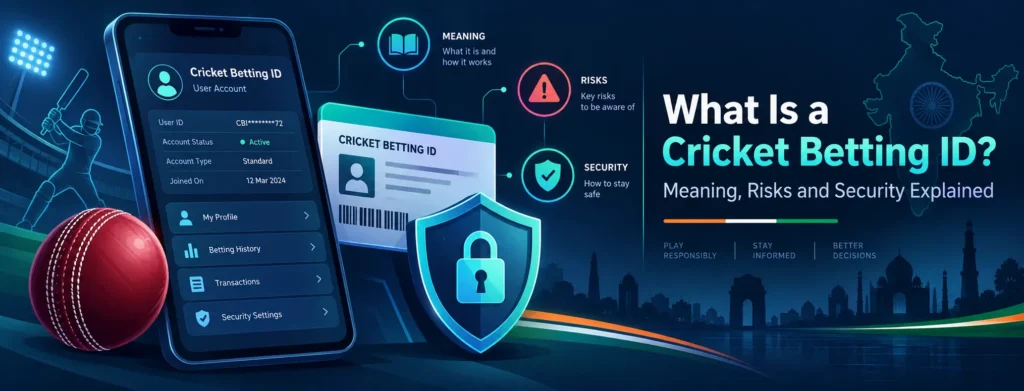
The term cricket betting ID appears frequently across websites, social media, WhatsApp groups and Telegram channels connected with online cricket wagering. Yet many people searching for a cricket ID do not fully understand what the term means, who controls the account, what personal information may be involved, or what risks come with using one.
At its simplest, a cricket betting ID is a username, login credential or account identifier used to access an online platform offering cricket-related wagering or other real-money gaming services.
However, the phrase “betting ID” is not an official regulatory category or government licence. Depending on how a particular system works, the account may be created directly by a website, issued through an agent or intermediary, or connected to a wider betting exchange or gaming panel.
That distinction matters.
A normal digital account created directly with a recognised service usually gives the account holder control over registration details, password recovery and account security. Some betting-ID systems, on the other hand, may depend heavily on agents or third parties who create credentials, manage balances or communicate with users through messaging applications.
This creates additional questions about privacy, payment safety, account ownership, fraud and legal compliance.
In 2026, those questions have become even more important because India’s online gaming regulatory framework has changed substantially.
What Does Cricket Betting ID Mean?
A cricket betting ID generally means the login details attached to an account through which a user can access cricket wagering markets or other real-money gaming features.
The term can refer to a username and password, but in practice the account may contain much more information, such as personal details, transaction records, account balances, device information and activity history.
Some platforms use standard self-registration systems where users create their own accounts. Other services operate through agents who issue credentials manually.
This is one reason two websites using the phrase online cricket betting ID may actually offer very different account structures.
The important thing to understand is that having an “ID” does not by itself prove that a platform is licensed, regulated, secure or permitted under Indian law.
Is a Cricket ID the Same as a Normal Online Account?
Not always.
A normal online account usually gives the user direct control over account creation, password recovery and security settings.
An agent-issued cricket ID may work differently.
| Normal Online Account | Agent-Issued Betting ID |
|---|---|
| User normally registers directly | Account may be created by a third party |
| User chooses credentials | Credentials may be assigned |
| Password recovery may use verified email or mobile | Recovery may depend on an agent |
| Payment records may appear directly in the platform | Payments may sometimes go through third parties |
| User usually manages personal information | Agent may hold some customer information |
| Platform support may be directly accessible | Support may depend on WhatsApp or Telegram contacts |
This difference is important from a security perspective.
If somebody else originally controls the email address, recovery method or master account connected to your login, you may not have complete control over the account even if you possess the username and password.
Why Are Cricket Betting IDs Commonly Discussed in India?
Cricket generates enormous online interest in India, particularly during tournaments such as the IPL, international series and ICC competitions.
That popularity has also led to widespread use of terms such as online cricket ID, cricket betting ID, betting exchange ID and online betting ID.
Many sites use these expressions interchangeably.
Competitor pages commonly describe an ID simply as an account that provides access to betting markets. Some also explain that the account can contain login information, transaction history and verification details.
The problem is that many articles stop at the account definition and immediately move toward registration, bonuses or deposits.
For users, the more important questions are:
Who actually controls the account?
Where is personal information stored?
Who receives payments?
Can the password be recovered independently?
Is the platform legally permitted?
What happens if money disappears?
And where can a user report fraud?
Those questions deserve more attention than promises of fast registration or quick withdrawals.
Is a Cricket Betting ID Legal in India in 2026?
The phrase cricket betting ID itself is simply terminology used online. The legal issue depends on what activity the ID provides access to.
India’s legal framework changed significantly through the Promotion and Regulation of Online Gaming Act, 2025 and the Promotion and Regulation of Online Gaming Rules, 2026.
The Rules came into force on May 1, 2026.
Under the current central framework, online money games are prohibited, including games involving financial stakes and expectations of monetary winnings. The prohibition applies whether the underlying game involves skill, chance or a combination of both.
The framework also prohibits advertising, promotion and facilitation of prohibited online money games, while banks and payment systems are barred from processing transactions linked to such games.
This is very different from many older articles that described Indian online betting primarily as a state-by-state “grey area.”
For a complete explanation of the updated law, readers should also see our “Is Online Betting Legal in India in 2026?” guide.
A Betting ID Is Not Proof of Legitimacy
One of the most important misconceptions is that terms such as:
“verified cricket ID”
“official ID”
“trusted ID”
“master ID”
or
“secure betting ID”
automatically mean that an account is regulated.
They do not.
These descriptions can be marketing terms rather than formal regulatory designations.
A website or agent should not be considered trustworthy merely because it provides an account number, displays a lock icon, claims to use encryption, or communicates through an established messaging platform.
Similarly, foreign registration or an offshore licence does not automatically determine whether the underlying service is lawful for users in India.
What Are the Main Risks of Cricket Betting IDs?
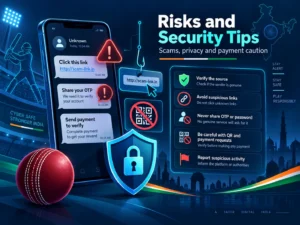
1. Account-Control Risk
One of the biggest risks arises when an account is created and managed through another person.
If an agent controls the recovery email, master login or administrative account, the user may be dependent on that person whenever a password is forgotten, an account becomes locked, or a dispute occurs.
This can make account recovery much harder than with a conventional platform.
2. Fake Cricket ID Providers
Search engines, social media and messaging applications contain many accounts claiming to provide “trusted” or “verified” betting IDs.
Not every claim can be independently verified.
A fraudulent operator may create a professional-looking website, use copied testimonials or screenshots and communicate through temporary numbers before requesting money.
The risk becomes greater when the entire relationship depends on a single WhatsApp or Telegram contact.
3. Payment Fraud
Payment handling deserves particular attention.
Government material examining illegal online betting operations has described cases where users were directed to send funds through instant payment methods into bank accounts not held in the platform’s name, including accounts operated by individuals or shell entities.
Such structures can make money difficult to trace if a dispute or fraud occurs.
Users should therefore treat requests to send money to unfamiliar personal accounts with extreme caution.
4. KYC and Identity-Theft Risk
Some services request identity documents such as PAN details, Aadhaar-related information, photographs or bank information.
Identity documents contain sensitive personal data.
Sending copies through unknown websites, messaging accounts or unverified agents creates the possibility that the information may be stored insecurely, copied or misused.
A platform requesting KYC documents should not automatically be assumed to be legitimate simply because it asks for verification.
5. Password and OTP Theft
A legitimate service should never require a user to share sensitive banking credentials such as a bank password, card PIN or UPI PIN.
The Reserve Bank of India repeatedly advises consumers not to share passwords, PINs, OTPs or other financial credentials and warns against suspicious links received through SMS, email and social media.
Those same precautions should be applied when dealing with any unfamiliar online gaming account.
6. Phishing Links
Fraudulent messages may imitate login pages or payment websites.
A message might claim:
“Your ID will expire.”
“Complete KYC now.”
“Click here to unlock withdrawal.”
“Claim your reward.”
or
“Update your betting account.”
The link may lead to a fake page designed to capture login credentials or banking details.
Never assume that a link is legitimate simply because it arrives from a familiar-looking profile.
7. Withdrawal Scams
Another common risk is being asked to make an additional payment before an existing balance can supposedly be released.
The request may be described as a verification charge, withdrawal tax, processing fee, security deposit or account-unlocking fee.
Repeated demands for additional payments are a serious warning sign.
8. Fake Guarantees
No legitimate financial activity should be evaluated solely on promises such as:
“100% guaranteed profit”
“fixed match”
“guaranteed winning ID”
“no-loss strategy”
or
“risk-free return.”
Cricket outcomes are uncertain, and claims of guaranteed betting profits should be treated with extreme caution.
Cricket Betting ID Security: What Should Users Protect?
Account security starts with control of personal credentials.
Anyone interacting with an online account should protect their password, mobile number, email access, identity documents and financial details.
A strong account-security approach should include one unique password for each service, two-factor authentication where available, direct control of the recovery email or mobile number, and regular review of login or transaction activity.
Users should also avoid storing sensitive passwords in messaging conversations or sending credentials to another person for “support.”
The Reserve Bank of India recommends using trusted and secure websites for financial activity and advises users never to share mobile-banking PINs, internet-banking credentials, passwords or OTPs.
Be Careful With QR Codes and UPI Requests
UPI and QR codes are convenient, but convenience does not eliminate fraud risk.
The RBI specifically warns users against scanning QR codes received from unknown sources and reminds users that entering a PIN or OTP is not required simply to receive money.
If somebody claims you need to scan an unknown QR code or enter a UPI PIN to receive winnings, refunds or withdrawals, stop and verify the request independently.
Cricket ID Scams on WhatsApp and Telegram
Messaging platforms make communication fast, but they can also make identity verification difficult.
Scammers can copy profile photos, business names and logos. A familiar-looking display name does not prove that the person behind the account is genuine.
Warning signs include frequent changes of payment account, pressure to transfer money quickly, promises of guaranteed returns, refusal to provide verifiable company information and instructions to keep transactions private.
Government material on illegal gaming and betting has specifically noted the use of social media and messaging platforms, including WhatsApp and Telegram, to attract users to unregulated apps and websites.
What Should You Do If You Suspect a Cricket ID Scam?
Do not send additional money simply because somebody promises that another payment will unlock an existing balance.
Save screenshots, payment references, phone numbers, usernames, website addresses and conversation histories.
If money was transferred through a bank or digital payment service, contact the bank or payment provider quickly.
Indian users can also report online financial fraud and other cybercrime through the National Cyber Crime Reporting Portal. The portal provides a route for reporting online financial fraud, mobile crimes, social-media crimes and related cyber offences.
Does SSL or HTTPS Mean a Betting Site Is Safe?
No.
HTTPS is important because it encrypts communication between your browser and the website.
However, HTTPS does not prove that the business itself is trustworthy.
A fraudulent website can also obtain an SSL certificate.
Users should therefore treat HTTPS as one technical security requirement rather than a guarantee of legitimacy.
Can Reviews Prove a Cricket ID Provider Is Genuine?
Reviews can provide useful context, but they should not be the only trust signal.
Online reviews can be manipulated, purchased or copied.
Screenshots showing withdrawals, account balances or customer chats can also be edited.
Better verification requires checking multiple independent sources and looking for clear ownership, transparent policies, consistent contact details and verifiable regulatory information.
What Information Should Never Be Shared?
Users should never disclose banking passwords, UPI PINs, ATM PINs, card PINs, OTPs or complete card security information to an agent or unknown support representative.
Be equally cautious with identity documents.
If verification is genuinely necessary for a permitted digital service, documents should be submitted only through an authorised and secure process with a clear privacy policy.
Never send sensitive documents simply because somebody on a messaging application says they are required immediately.
Cricket Betting ID vs Cricket Fan Account
It is important not to confuse a betting ID with a normal cricket-related account.
A user account for a cricket news website, fantasy-free social game, match-streaming service, fan community or statistics application is not automatically a betting account.
The difference is usually determined by the activity available through the account.
If money or something carrying monetary value is staked with an expectation of receiving financial winnings, the activity raises very different legal and financial considerations from simply viewing cricket scores or participating in a free social game.
What Has Changed for Online Gaming in India?
India’s 2026 framework distinguishes prohibited online money games from categories such as e-sports and online social games.
The government has established the Online Gaming Authority of India as part of the new structure and introduced procedures for classifying games.
Factors used in classification include whether users pay stakes, whether monetary winnings are expected, the revenue model and how game assets are monetised.
This means businesses cannot determine their regulatory status merely by calling a product a “skill game,” “social game” or “cricket platform.” The actual structure of the activity matters.
Why Users Should Be Wary of Older Cricket Betting Guides
Many articles currently appearing online were written before May 2026.
You may still encounter claims such as:
“Online betting is not banned nationally.”
“Offshore platforms are generally legal.”
“Games of skill are exempt.”
or
“Indian law does not cover internet betting.”
Those claims may reflect older interpretations, but they do not provide a complete description of the current central framework.
Whenever researching online betting in India, check the publication or last-updated date.
For a detailed overview of the latest rules, read our guide: “Is Online Betting Legal in India in 2026? What the New Online Gaming Law Means.”
FAQs About Cricket Betting IDs
What is a cricket betting ID?
A cricket betting ID generally means a username, login account or set of credentials associated with an online platform that offers cricket wagering or other real-money gaming features.
Is a cricket ID the same as a betting account?
In many cases, yes. “Cricket ID” is often informal shorthand for an account used to access cricket-related betting markets. However, the exact account structure varies between platforms.
Is a cricket betting ID legal in India?
An ID itself is simply an account identifier. The legal issue depends on what activity it provides access to. Under India’s current central framework, online money games are prohibited.
Is a verified cricket ID completely safe?
No. The word “verified” does not guarantee regulatory approval, account security, payment safety or legitimacy.
Should I share my OTP with an ID provider?
No. Banking OTPs, passwords, PINs and UPI PINs should never be shared with agents or unknown parties.
Can someone steal money using a fake cricket ID?
Fraudulent account providers can potentially misuse payments, credentials or personal data. This is why users should be extremely cautious about unverified platforms, personal payment accounts and suspicious links.
Is WhatsApp enough to verify an online betting provider?
No. A WhatsApp profile or business account does not prove that an operator is legally authorised or trustworthy.
What should I do if I have already sent money to a suspected scammer?
Save all transaction details and conversations, contact your bank or payment provider promptly and consider reporting the matter through India’s National Cyber Crime Reporting Portal.
Final Thoughts
A cricket betting ID may sound like nothing more than a username and password, but the risks surrounding these accounts can be much broader.
Users may be dealing not only with an online account but also with third-party agents, payment intermediaries, identity verification requests and services operating across different jurisdictions.
That creates potential issues involving account ownership, personal-data security, payment fraud, phishing, fake providers and legal compliance.
The situation is especially important in India in 2026 because the legal framework surrounding online money gaming has changed substantially.
The safest approach is to treat claims such as “trusted,” “verified,” “guaranteed,” “official” or “secure” as marketing language unless they can be independently verified.
Never share banking passwords, OTPs or UPI PINs, be cautious with unknown QR codes and personal payment accounts, and verify current laws rather than relying on outdated betting articles.
When money, personal identity documents or financial credentials are involved, caution is more important than convenience.